
• LIKE on Facebook • FOLLOW on X/Twitter • FOLLOW on Instagram
• SUBSCRIBE on YouTube • BUY ME A COFFEE on Ko-Fi
Director: Luca Guadagino
Stars: Julia Roberts, Ayo Edebiri, Andrew Garfield, Michael Stuhlbarg
Distributor: Sony Pictures Releasing
“Not everything is supposed to make you comfortable, Maggie.”
Julia Roberts delivers what is normally considered a “career-defining” performance, though the film itself mismatches the quality of its star. From Luca Guadagino, After the Hunt presents Julia Roberts at her best, but the misfortune is that the film itself is a convoluted struggle within itself.
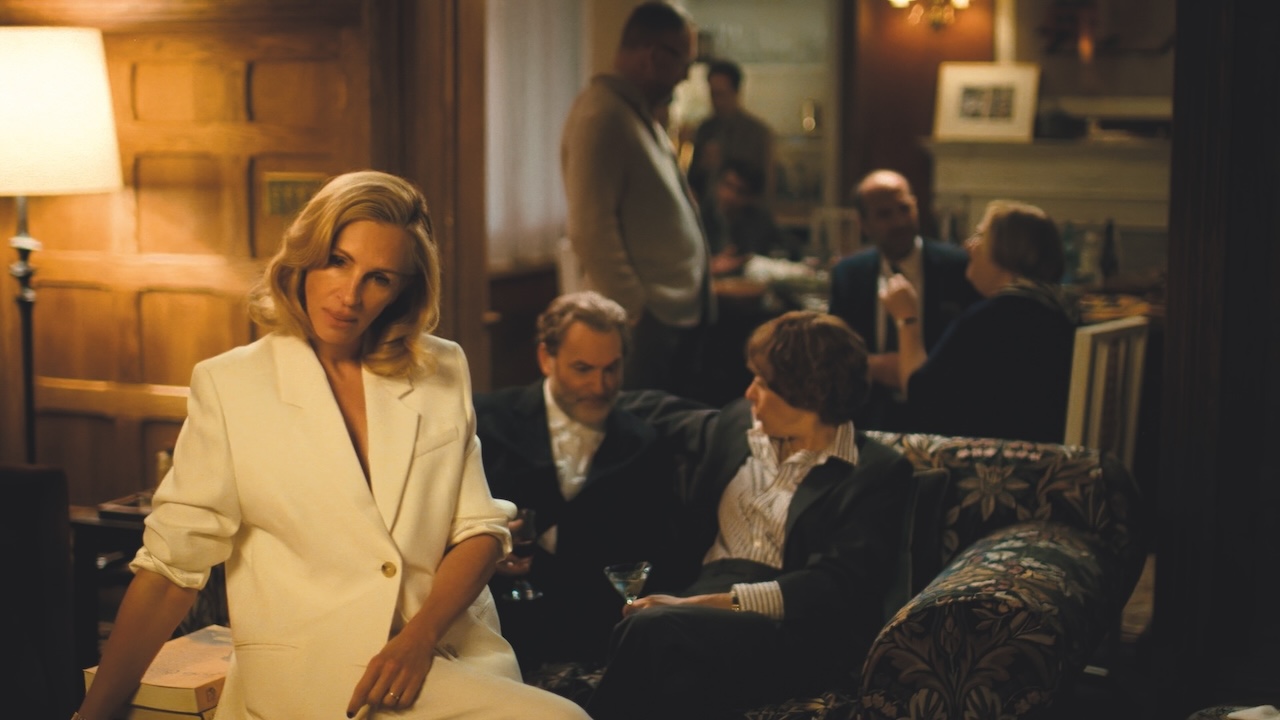
Julia Roberts is Alma – a very well-established, tenure-bound professor at Yale. Specialising in philosophy, her colleagues include Andrew Garfield’s Hank. We begin with seeing these privileged characters at a party within the apartment of Alma and her psychiatrist husband, Frederik (Michael Stuhlbarg), where talented PhDstudent, Maggie (Ayo Edebiri) is also present. Alcohol, nibbles, and discussions of masculinity and gender take place, much to the annoyance of anyone in disagreement. Friendly debate. Pretentious aurora. You get the gist.
Maggie, who finds inspiration in Alma as both a scholar and a person, comes to her in a vital cry for help: she’s been sexually assaulted by another member of staff. This bombshell news brings dismay for Alma as she faces conflictions both personally and professionally. Rather than outright care for Maggie. In this state of disarray, the alleged assault, the denial, the falsehoods and deceit, and so on, worsen Alma both mentally and physically. Dealing with health issues, clear alcoholism, and past trauma, Alma is in psychological disarray, not knowing where to turn or who to turn to.
Quite often, After the Hunt is overly critical of its younger characters and the new generation in general. Often criticised for taking easier routes, having things spoonfed, and having much easier access, those that are young within the film are prone to consistent criticism, even if it comes across as ironic. At times, the fragile state and uselessness of the young generation within After the Hunt feels aggressively exaggerated to both poke fun at the young and make a point of how dumb young people are.
Additionally, After the Hunt occasionally has the ambiance of being quite negative in a post-#MeToo existence, even a slap in the face. The notion of suggesting its female characters to be profound liars feels quite off. Perhaps, the point of the filmic text is that all young people are awful. An interesting ideology within the film, but perhaps, a commentary on select people within privileged positions holding such opinions.
Though quite often the story direction of After the Hunt is unclear, the layered performances of its cast members manages to glue together any incoherence. Ultimately, the character performances completely outweigh much of the film in general. Julia Roberts has very well delivered a career best performance – potentially a future recipient in Awards Season. As an ensemble, the performances are terrific – Roberts the obvious stand-out – whilst the up-and-down nature of Edebiri’s Maggie is a fascinating watch. Stuhlbarg’s Frederik is probably the best character – easily the most grounded, most logical, and generally fair – there is an obviousness that he isn’t affiliated to philosophy and ideology.
Ultimately, After the Hunt is underwhelming as a psychological thriller, though there are intrigues and curiosities present as when watching the film, there is a feeling that the direction could go anywhere. Sadly, there are no iconic twists like those in 90s thrillers, but the performances are exceptional at times.
Many thanks to BFI London Film Festival for the pleasure of this film.
3 Stars
Dom.
For John.
This article’s featured image: By Source, BFI LFF, Fair Use https://whatson.bfi.org.uk/lff/Online/default.asp?BOparam::WScontent::loadArticle::permalink=after-the-hunt-lff25&BOparam::WScontent::loadArticle::context_id=
 DomOnFilm